Can the Your Consumer Unit Explained: What Those Switches Actually Do.
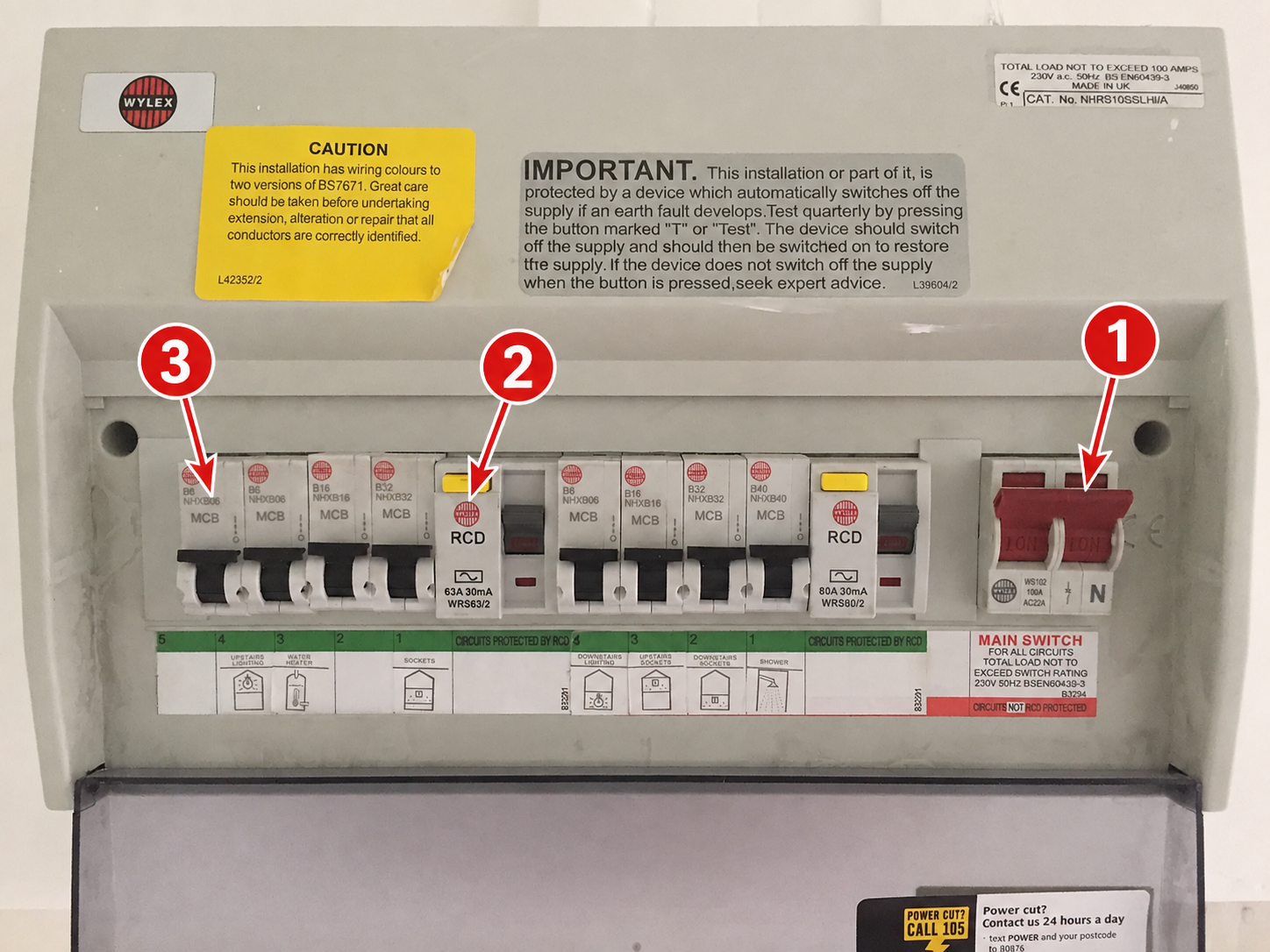
The three main components
Most traditional consumer units will contain three main types of protective device: the main switch, RCDs and MCBs.
Modern installations can be arranged differently and may use RCBOs, which combine some of the functions of an RCD and MCB. But for understanding many common domestic consumer units, these three components are a useful starting point
1. The main switch
The main switch is usually one of the larger switches in the consumer unit. It is often at one end of the row, although the exact arrangement can vary.
It controls the supply to the consumer unit and can be used to switch off the electrical installation.
It is often identifiable by a larger switch or red lever, although don't rely on colour alone
2. The RCD
Many domestic consumer units have one or two RCDs.
An RCD is designed to detect an imbalance between the electricity flowing out through a circuit and the electricity returning.
If it detects a potentially dangerous leakage of current, it can disconnect the supply very quickly.
For example, if an electrical cable becomes damaged or electricity finds an unintended path to earth, the RCD may trip.
You'll normally be able to identify an RCD because it is a larger device and has a test button, often marked with a T.
Some consumer units have two RCDs, with different groups of circuits protected by each one.
So why does this matter?
An RCD can trip when it detects a fault, which means you may suddenly lose power to several circuits at once.
It can be frustrating — but the RCD has potentially done exactly what it was designed to do.
3. MCBs
You'll normally find several smaller switches called MCBs, or Miniature Circuit Breakers.
These protect individual circuits.
For example, you might have separate circuits for:
Downstairs sockets Upstairs sockets Lighting Cooker Shower Outdoor power
The exact arrangement will vary from house to house.
The MCBs may be labelled, but don't assume the labels are correct. Installations can be altered over the years, and labels aren't always updated.
So how does it all work together?
Imagine your downstairs lighting circuit develops a fault.
The MCB protects that particular circuit.
If a fault causes the MCB to trip, the other circuits in the house may continue working.
An RCD works at a different level. Depending on how your consumer unit is arranged, an RCD may protect a group of circuits.
So if that RCD trips, you could suddenly lose power to several circuits at once.
This is why it can look like you've suddenly lost half the house.
What should you do if your power goes off?
If you've lost power and you've established that the problem is within your home's electrical installation, you can check the accessible switches on your consumer unit.
Step 1 — Look at the switches
Open only the outer door/lid that gives you access to the switches.
Do not remove the consumer unit cover.
Before touching anything, I recommend taking a photograph of the consumer unit.
If you eventually need an electrician, that photograph can potentially help show them what the board looked like before you changed anything.
Look for a switch that has moved to the off/tripped position.
Step 2 — If an RCD has tripped
If you can identify an RCD that has tripped, try resetting it once.
Don't hold the switch in position or repeatedly try to reset it.
If it immediately trips again, leave it off and move on to the next step.
Step 3 — Turn off the MCBs supplied by that RCD
If the RCD won't stay on, turn off the MCBs that are protected by that RCD.
Then try resetting the RCD.
If the RCD now stays on, this tells you that one of the circuits it protects may be responsible for the problem.
Step 4 — Identify the circuit
With the RCD staying on, turn the MCBs back on one at a time.
If switching one particular MCB back on causes the RCD to trip again, you've potentially identified the circuit associated with the fault.
Leave that MCB switched off.
You can then reset the RCD so that the other circuits protected by it can remain operational.
You've now potentially established:
Which circuit is causing the problem + which parts of the house can safely remain powered.
Step 5 — Call an electrician
Now you've got some useful information to give the electrician.
Instead of simply saying:
"My electricity keeps tripping."
you can explain:
"The RCD trips when I switch on the MCB labelled downstairs sockets."
That gives the electrician a much better starting point.
And importantly, don't keep resetting the faulty circuit just to get it working.
The trip is telling you that something needs investigating.
One final thing
A tripping RCD doesn't necessarily mean that the RCD itself is faulty.
It could be detecting a problem with:
An appliance Wiring Moisture A damaged cable Another part of the electrical installation
And sometimes faults can be intermittent, so successfully resetting an RCD doesn't necessarily mean the underlying problem has gone away.
If you're unsure what's happened, leave the affected circuit switched off and get it checked.
The simple version
Main switch: Controls the supply to the consumer unit.
MCB: Protects an individual circuit.
RCD: Monitors for certain types of electrical leakage and can disconnect a group of circuits when it detects a problem.
And the most important rule:
You can operate the switches you're supposed to operate. You should never remove the cover of the consumer unit and start investigating what's inside.